Monday, November 15, 2010

Program Snapshot: Afternoons in the 3rd grade

We have four different tutoring programs within DC READS: our traditional one-to-one after-school tutoring for third graders; Saturday tutoring at libraries and community centers; morning tutoring, where we serve as de-facto teachers' assistants in classrooms for all the different elementary school grades; and then our 4th and 5th grade program, which functions as an after-school classroom run by a group of tutors and coordinators and focuses on personal development goals, writing, vocabulary, and other forms of student enrichment. Over the course of this year, we'll be posting a mixture of tutor and coordinator reflections to allow us to convey our experience as educators and mentors, while also filling our readers in on exciting developments within each of our programs.

****

The following post was written by Justine Achille, a sophomore in the NHS who is currently tutoring at Kenilworth Elementary School:


The session was going to go great. I knew it. I had printed out a vocabulary activity that I made up that I knew my tutee would enjoy, and I was bringing the white board. I didn’t really have a plan as to what to do with it, but that didn’t matter. As a rule, all tutees love using white dry-erase boards, and mine is no exception. So in my mind, the day was going to be a hit, without a doubt, and at first, everything was going just as planned. We ambled through a book about a nice woman who owned “The Strawberry Inn,” and then we began to tackle my vocab worksheet.

Outside of Kenilworth Elementary
First, I should probably back-track and explain that my tutee has been obsessed with the idea of “creating a community.” When I first heard this I was completely blown away. My tutee, this little third grader, is thinking of ways to build a good community! So I asked her how she would go about doing this, excited about what kind of insight she might have about the workings of a community or town. Her reply was something along the lines of: well… we could use milk cartons…and construction paper….and…Of course. She means literally, let’s build a community. I have to say, I should have probably expected this. But nonetheless, I decided to try to work with the idea. 


Thus the vocab worksheet was full of words describing either components of a good community, or those of a bad one. Her job was to read the words, try to understand their meanings, and decide if they should be part of this imaginary community. Wanting to challenge her, I threw in some words that I knew she would not recognize, but I hoped that together we could define them, and then she could learn their meanings. The first words we came to were “GREEN SPACE,” as in parks or something of the sort; the word was circled. Perfect. Next was “SIDEWALKS,” again, circled. Great. Then we got to “LAW ENFORCEMENT”; I expected that she might not know the meaning of this one immediately, so I was prepared for her pause. She began to read the word out loud. “Law,” she said confidently, and then stopped. I gave her another second to think, but instead of moving on, she looked to me. I then began with the old standby: now, let’s try to sound it out. And so we did. Or, I should say, I did.

We began with the very first letter: e. What sound does the “e” make? She excitedly responded with “Eh! Eh! Eh!” Correct. We moved on. The “n” to my surprise, made the “Mmmm mmmm” sound. Close. But not quite. After a quizzical look up at me, I gave in. It makes the “Nuh nuh nuh” sound, I confessed. Unfortunately, the rest of the word followed in a manner much like the “n.” Without wanting to lose the whole purpose of the activity, I shook if off, chalking up her mistakes to unfamiliarity with the new word, and we began to try to dissect its meaning. Thankfully, after finding the word “force” hidden in there, we were able to come to the definition rather quickly. I think both my tutee and I were a little wary to continue, given the amount of errors we encountered with “LAW ENFORCEMENT,” but nonetheless, we proceeded cautiously through the activity. After a lot more help on my part than I had originally anticipated, we finished, and I came to a decision about how we should use the white board that day: we would review phonics.

I started by writing the letter “D” on the board and asking her to give me the sound or sounds it makes and a word that begins with that letter. Without hesitation she complied. To make it fun, I let her take a turn and quiz me – tutees seem to love feeling like they are controlling the game. She gave me a letter and then we switched back. The game continued smoothly, building her self-confidence and my confidence in her. However, when we got to “c,” things got rocky again. I know “c” is tough; who would expect it to sometimes be an “s” in disguise? Certainly not me! But nonetheless, it is something that every child needs to learn to recognize eventually. When I pushed for a second sound that this letter might make, she began guessing at random, giving me any sound she knew. With a slow nod of resignation, I once again gave in and made the sound for her.

We moved on to vowels, and to my surprise, it was “long” vowel sounds that seemed to trouble my tutee the most. She stared at the large round “O” I had written on the board, and as the seconds went by, I closed my eyes a moment and just hoped that she would come up with the right sound. She had already done the hard part and given me the short “o” at the beginning of “octopus,” but as I continued to press: and what sound does the second “o” in octopus make? I received nothing but blank stares. She finally smiled and said “ohhh! I know!” Yes, yes yes! That’s exactly right! But wait, she wasn’t finished: “ohhh! I know!” she said, “It’s the puh puh puh sound!”

I froze, and prayed that my face was not betraying my true emotions.

I was crestfallen in the truest sense of the word. I, of course, had thought her original exclamation was her answer. As she continued to smile up at me, looking completely pleased with herself, I couldn’t speak. This beautiful, enthusiastic eight year-old girl does not know the sounds of the alphabet. Dumbstruck I just sat there for a moment, but the longer I waited, the more confused she was getting, and the angrier I became on the inside. How could her school have let her move on to the third grade without making sure she knew the sound of every letter of the alphabet? How could they let such a devastating learning deficit slip through the cracks? What teacher, who spends two hundred-odd days of the year with her, had not spotted this problem, which I had picked up on in only my fourth hour of knowing her? She is in the third grade! I was appalled and outraged and frustrated and more than anything else, deeply saddened by my discovery. 

Not knowing what else to do, I slapped a smile back on. Close, I told her, let’s try it again. The day certainly was not a hit. By the end of the session my tutee was visibly dejected as one can only be from trying and failing time after time after time. Hey, I said, you did a great job today. I held out my hand, our cue for our secret handshake. Slowly, she looked up, and seeing my gesture, a smile spread across her face. At the end of that long day, I couldn’t help but feel a new sense of urgency in my position as a tutor. It’s tough days like these that make me realize how the DC public school system struggles to serve their youth, but it is smiles like the one I saw on my tutee’s face that remind me that what I can do, even though it may not be much, is enough to make a difference. This is why I tutor.

Friday, November 12, 2010

To me, education...

We're starting a new feature here on the DC Reads blog.  It's an idea born out of our excellent tutor advocacy committee, which is currently doing a yeoman's job helping to advocate for just education throughout Washington, DC.  More on that as the year progresses.

Anyway, in our last meeting we were sitting around talking about things we can include on the blog, and one of our members came up with a very simple concept: one sentence, from everyone on the committee, describing what education means to them.  Brilliant!

So from now on, throughout the year, we'll be posting one of these sentences each week.  Our inaugural sentence comes from Hannah Hill:

"To me, education is the only national tool that ubiquitously provides a forum for reform and development."

Well put.  Stay tuned for more -- and as always, happy reading!

Tuesday, November 9, 2010

Vincent Gray Ward 8 Town Hall Meeting

By: Hannah Klusendorf

Last week, in a crowded Ward 8 church, fifteen DC Reads coordinators and tutors gathered with nearly a thousand Ward 8-ers to hear future DC mayor, Vince Gray, overview his proposed agenda. A waning sound system and a delayed start aside, the town hall meeting provided me with some illuminating, though vague, information in regards to education. After promising to unite the Wards together to form one DC, Gray turned his attention to creating one DCPS.


Gray claimed that rumblings alleging he would “turn the clock back on education” were “ridiculous.” He spoke of his positive voting record within the Council for education reform measures – a point he brought up many times while on the campaign trail. But that night, he seemed to directly speak out against Rhee and her supporters. Following the primary election results, she did call Gray’s victory “devastating to the children of Washington, DC.” Gray reassured all that there is “only one thing that matters: improving the educational outcome for the children of the District of Columbia.” Duh.


DC is home to a broad and differing range of opinions and ideas, but I do not think (at least I strongly hope) that few find Gray’s statement to be controversial. Some, however, might take issue with his plans for actually accomplishing this necessary yet lofty task. Personally, I have yet to see a fully-realized, concrete plan for actually doing this, as was evident in the following minutes.

Gray stated his vision for a public education system that carries a child from birth to age twenty-four. He stressed the successful creation of formal early childhood education programs within the District. According to him, DC is the first “state” in America to say that there is seat in a pre-kindergarten program for every 3 and 4 year-old. DC Action for Children is working to confirm this. I also tried researching his claim, but I came up with inconclusive results. Drawing upon this supposed success, Gray went on to say that he wants to extend formal education to include children as early as six-months-old because for some children, “three years old is too late.” Not only with this access to education be beneficial for the children, but it will also teach the parents how to be better parents.

As the crowd loudly clapped at this remark, I could not help but think about and question what this proposed system. Clearly, this idea hopes to replant the Harlem Children's Zone in DC, but how exactly will this move look? How much will DC's version resemble this model. What will this program for six-month-olds be? Is it a glorified child care? What does a post-secondary program look like for a twenty-four-year-old still in DCPS? Is it a variation of college or more vocational in nature? Gray’s statements raised many more questions than they answered. He did not elaborate on any specifics of his vision of a DCPS extending from the cradle to adulthood If someone did not know of Geoffery Canada's Harlem Children Zone was prior to this meeting, then he or she would not have any clue as to what Gray's plan even means for DC. Moreover, he prefaced this whole conversation with “We will work on these when we get into better times.” Considering the current state of the economy and the eventual budget cuts DCPS most likely faces, can Gray even guarantee that these broad plans will be enacted?

Another policy that lacked specificity pertained to charter schools. According to him, 30,000 students in DC attend these schools; some parents clearly prefer them. “We,” Gray stated, “Need to work to make sure that public schools are great, too.” Both systems should grow and develop, and parents should be able to choose type of school their children attend. Working with a program that serves in public schools, I agree wholeheartedly with Gray’s statement. Although I had hoped that he would offer concrete ways to promote the growth of public schools, I was glad that at least our mayor is aware of this public school need.

In regards to high school, Gray talked about the merits of developing career and technical components in every high school across the city, so “that kids who want to go to work after the twelve-grade have a set of marketable skills.” Once again, he did not offer a timeline for such plans, reiterating, “We will work on these when we get into better times.” I agree that college is not the life path for every student in the United States. Vocational training would be invaluable for those not planning on pursuing a higher level of education. However, I wished that Gray mentioned the need to foster a college-going culture within DCPS. Attending college is not so unattainable goal as many students might think. True, Gray did bring up the University the District of Columbia and the need to show pride for our state university. He did not, though, link the University to DCPS and its potential college students.

As Gray left the education question to pursue other areas of interest and answer audience questions, I still wanted more. True, the nature of this town hall was not to outline his exact plans for DC. At the time of the town hall, the mayoral election was still a week away. Clearly, he was going to stay away from anything too controversial less he bite the hand that feeds him.

Gray’s speech was a verbal victory lap of sorts. Ward 8 alone gave him 10,500 votes in his primary win. Combined with Ward 7’s 14,500 votes, he received nearly 34% of his votes from these two wards. Being with nearly a thousand community members all clamoring to have their questions answered and their voices heard made me realize the power of an engaged community. Now, that Vincent Gray can officially claim the title of DC’s mayor, I look forward to learning more about his ideas for DCPS. I want to know the specificities of his administration’s idea of education reform. DC Reads started before Rhee assumed the Chancellorship, and it will continue to survive in a Rhee-less DC. Hopefully, Gray’s plans can support our own mission and vision for DCPS.

If you want to learn more about the Ward 8 Town Hall Meeting, the entire event is available to watch here


Wednesday, October 27, 2010

DC Reads Program Snapshot: 4th and 5th Grade

We have four different tutoring programs within DC READS: our traditional one-to-one after-school tutoring for third graders; Saturday tutoring at libraries and community centers; morning tutoring, where we serve as de-facto teachers' assistants in classrooms for all the different elementary school grades; and then our 4th and 5th grade program, which functions as an after-school classroom run by a group of tutors and coordinators and focuses on personal development goals, writing, vocabulary, and other forms of student enrichment. Over the course of this year, we'll be posting a mixture of tutor and coordinator reflections to allow us to convey our experience as educators and mentors, while also filling our readers in on exciting developments within each of our programs.

****


Coordinator Reflection: Matt Buccelli

This past Thursday in our 4th and 5th grade classroom at Houston Elementary School, we had a "poetry café" to celebrate some of the work our students have been doing and give them a chance to share their creative material. For the previous two weeks, we had been teaching a unit on poetry and its different styles. After going over basic poetry terms like rhyme, couplet, alliteration, stanza, and syllable using the rap song "I Can," by Nas, we spent four classes teaching our kids to write acrostics, haiku, cinquains, and free verse poems. During each class, students had the chance to share their work quietly with a friend or individual teacher, but we intentionally put off having kids share their poems with the class and instead reminded our students during each lesson that if they behaved well and continued to worked hard, our efforts at writing would build up to a class spent sharing our poetry and eating treats. In each class building up to the poetry café, every student in class wrote at least one poem in each style; some who finished early wrote more, while others chose to draw illustrations to go along with their poems. Many of our students had the opportunity to draw illustrations but chose to write more poems instead.


So by the time we had our café last Thursday, each student had plenty of material to work with. We began the class with a 30 minute game of "Jeopardy!" to review the vocab words (one "Word of the Day" each day) that we had been learning, with the winning team getting first dibs on the cookies and brownies we brought as treats. Then we rearranged the room so that the clusters of desks normally scattered across the middle were moved to the walls and we could all make a circle with teachers and students sitting together on the floor. Once the whole class had had a chance to get a plate of cookies and brownies and a drink, one of our teachers introduced each student and allowed them to share their poetry. Each student was instructed to pick one piece of work to share -- once the entire class had gone, students who wished to share another poem were the given the opportunity to do so.

Aside from being lots of fun, I think the poetry café really demonstrates some of the ways that programs like DC Reads can enrich the academic experience of our kids. Our 4th graders have an excellent teacher in Ms. Crump at Houston, but with all the learning standards and academic material to cover during normal school hours, even if writing and poetry are part of the curriculum (as they should be -- and are in Ms. Crump's class), it can be hard for even the most skilled teacher to find time to work in something like the poetry café. While DC Reads, in all of our programs, spends a lot of time working on basic literacy skills and teaching academic material, like our Words of the Day and the poetry terms we introduced, we also have a lot of freedom and leeway to incorporate a celebration like the one we had last Thursday, which was great on so many levels. Not only was it a fun after-school activity; as a class, it also allowed all of us -- teachers and students -- to celebrate the hard work and learning we've already done together in this young year, while further building the relationships, trust, and goodwill between us and our students that will help us set the stage for more learning to take place in the coming weeks and months.

If you have an experience from site that you want to share, please contact me at mrb73@georgetown.edu so we can feature it on the blog!

Happy reading,

Matt

Friday, October 15, 2010

Rhee Out, Henderson In


By: Hannah Klusendorf
Since Adrian Fenty's defeat in the DC mayoral primary, there has been much speculation as to the fate of his right-hand woman, Michelle Rhee. After all, she did support Fenty's bid for re-election, and while campaigning for him, she hinted that a victory for Grey would mean resignation for her. It’s no secret that Gray and Rhee have had a pretty rocky relationship in the past. When asked about the possibility of keeping Rhee, Grey responded, "Well, we'll see."

Apparently, Gray and Rhee saw something. 


This Wednesday, October 13th, Rhee announced that she would resign as DC Public Schools Chancellor at the end of the month. Gray picked, Kaya Henderson, DC's Deputy Chancellor, as Rhee's interim successor. She first got involved with education reform and policy by working for Teach for America as a middle school Spanish teacher in the Bronx and as the executive director of Teach for America-DC. After her TFA stint, Henderson served Vice-President for Strategic Partnerships in Rhee's The New Teacher Project. She also launched alternative teaching certification programs, including the DC Teaching Fellows Program. Most importantly for all you Georgetown readers, Henderson is a Hoya twice over; she received her undergraduate and master's degrees at Georgetown. 
According to Rhee, "She's everything you'd want in a leader. She has the ability to motivate people. She's a critical thinker, and she's an innovative thinker." In light of this glowing praise, why did Gray appoint Henderson, a clear supporter of many Rhee policies? What does Henderson's chancellorship mean for the students of DCPS? 
In Henderson, Gray inherits in many ways a mini-Rhee. Both subscribe to the same vision of education reform, chiefly that student success depends most heavily on teacher quality. Henderson was Rhee’s first appointee, and they have been working together for the past decade. In the controversial firing of 98 central office staff members in 2008, Henderson, as deputy chancellor of “human capital,” played an important role. Despite Henderson’s close relationship to Rhee and her policies, Gray and his staff must have seen something in Henderson. Although she successfully negotiated a new labor pact with the Washington Teachers’ Union that bases job security on classroom performance rather than tenure, Henderson maintains a decent relationship with the teachers’ union president, George Parker whose union backed Gray in the primary. Also, according to at least one senior education adviser to Gray, Henderson’s political and presentational skills are stronger than those of Rhee’s. 
Whatever the reasons may be for Henderson’s appointment, one must wonder how she fits into Gray’s message of “community engagement and collaboration.” He has said that he “has no intention of micromanaging DCPS,” but how much freedom will Henderson – someone the Gray camp considers to be a permanent chancellor replacement – have to continue with the reforms set in motion by Rhee or even to forge a different path? 
According to Henderson, "Our responsibility is to deliver the goods, no matter what the situations our students are in. The reform is in the schoolhouse.” I look forward to watching how she intends on reforming the schoolhouse as the new Chancellor of DCPS.

Tuesday, October 12, 2010

Ward 7 Promise Neighborhood Celebration

This Saturday, several DC Reads coordinators attended a neighborhood celebration to mark the awarding of a $500,000 federal grant to the Parkside-Kenilworth community in Ward 7 for the planning and implementation of a new Promise Neighborhood. The site in Ward 7 is one of 21 across the country that was recently selected by the U.S. Department of Education for its Promise Neighborhood Planning Grant program, and it includes Kenilworth Elementary School, which is one of the places where we tutor on Friday afternoons.

Location of the new Promise Neighborhood (click to enlarge)

DC's Promise Neighborhood will be modeled, in part, after the Harlem Children's Zone in New York, which spans a 100 block radius and takes a community-based approach to improving educational outcomes for kids. The idea is that by working to comprehensively build communities, we will also insure that students achieve at a higher level; both the Harlem Children's Zone and the Promise Neighborhood planned for DC seek to foster a safe, nurturing environment for kids by combining good schools, after-school programs, and other opportunities to engage youth with affordable housing and health care, job training, and other so-called "wraparound services" for adults.

The celebration on Saturday took place at the Mayfair Mansions, a sprawling complex of several apartment buildings in the Promise Neighborhood community. There was free food and a live DJ who led several games of musical chairs with the children in attendance. There were also two ponies. At one point, about two dozen people got up to do the Cha-Cha Slide, which drew Noelle's excitement, and she did an awesome job following along.

Noelle does the Cha-Cha Slide

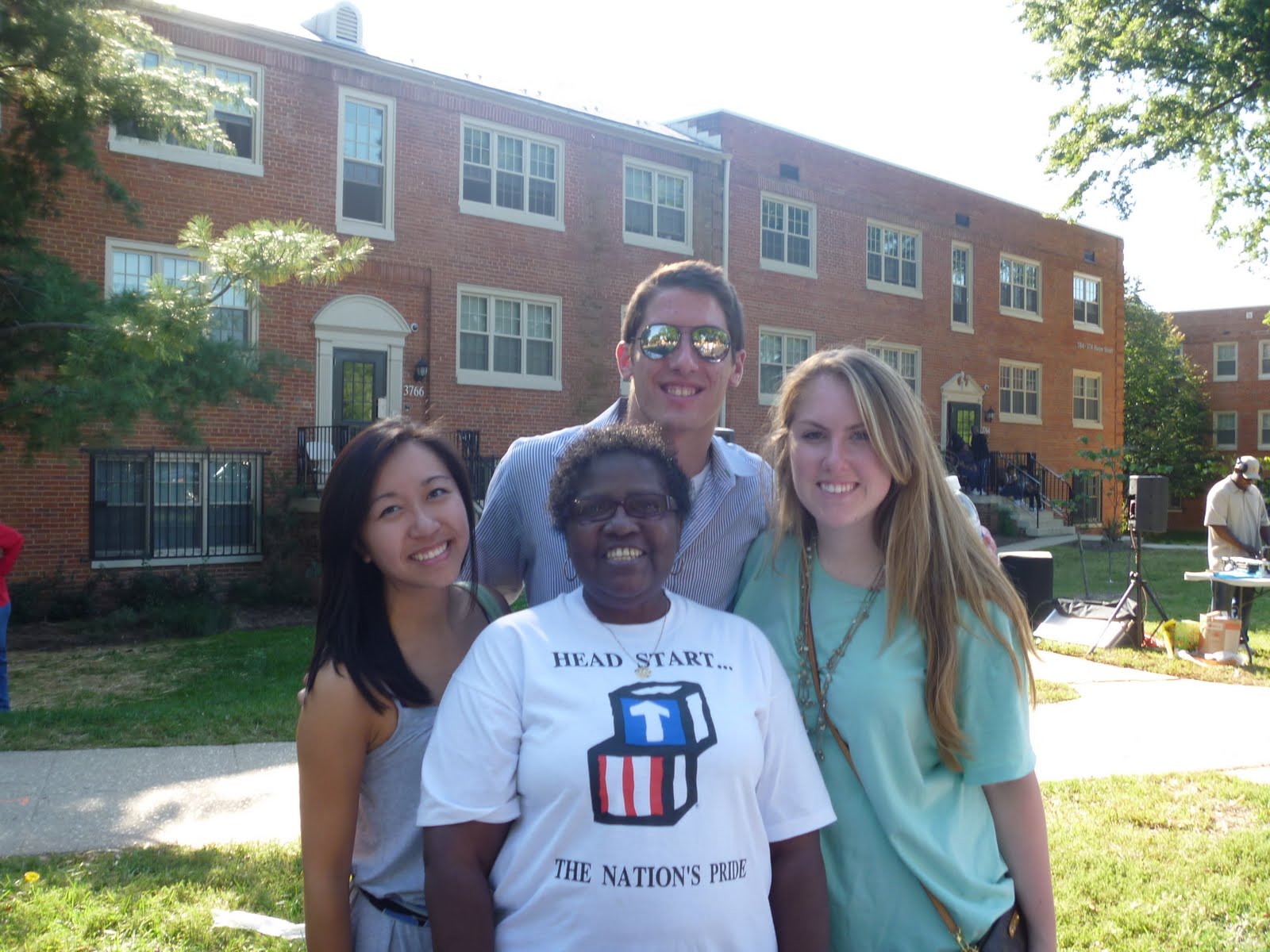
Several community-based organizations that will be involved with the new Promise Neighborhood were also in attendance, so it was good for DC Reads to be present and explain our role in the community. Certainly our tutoring program plays a big part in offering the kind of comprehensive support for kids that the Kenilworth-Parkside neighborhood will aim to encourage with its new grant, and we did a lot of networking with the other organizations that were out on Saturday. The woman representing Head Start, which helps low-income kids go to preschool, actually turned out to be the grandmother of one of my tutees in the fourth and fifth grade program at Houston Elementary School, which is located just outside of the Promise Neighborhood area. Aside from being a nice coincidence, I think this really illustrates why DC Reads tries to establish its presence in the communities where we serve. The more we can show up and make connections with people who have a stake in our success, the more successful we will ultimately be.


For more information on the Parkside-Kenilworth Promise Neighborhood, check out their website. We'll also keep you updated on its progress as the year progresses.

Monday, October 4, 2010

This week in education: New page on the Huffington Post

The Huffington Post has just launched a new education page as part of its sprawling website. For those of you who read the Huffington Post (and those who don't!), the page follows the same basic layout as the rest of the website, with top stories and relevant education news running down the center, flanked by video links and columns by various players in the education world.

Portraying the new page as a response to the growing interest throughout the country in education issues, Huffington Post founder Arianna Huffington asserted in a post to the main website that America is having an "education moment." We at DC Reads certainly hope she's right: from our ongoing work in schools, we know that fixing the education system in America will not be easy. Still, tackling this eminently pressing issue with the thought, care, and critical thinking it deserves requires as much of a sense of urgency as this country can possibly muster. The more informed people are about not only achievement gaps and other struggles in urban schools, but also the stagnation and mediocrity of the US education system as a whole, the more we can encourage innovation and find diverse, well-thought out solutions that tackle the array of tangling and complex issues that have long complicated efforts to improve public schools.

To view the Huffington Post education page, click here. From now on, it will also appear as a link in our sidebar.

Happy reading!