By Matt Buccelli
I'm taking a class on Washington, DC history this semester, and a couple weeks ago we had a local talk radio host (Mark Plotkin for WTOP FM) come and talk to us about local DC politics and other related issues. Mr. Plotkin has lived in this city since he was a student at GW in the 1960s, so he had plenty of perspective to offer. When the conversation turned to DC voting rights, and the injustice of living in a city that is federally taxed but not federally represented, the class talked about how people here and around the country seem to be complacent toward, if not completely ignorant of, the voting rights issue. Mr. Plotkin gave his opinion that it would take something dramatic, something eye-opening, a we're-not-going-to-take-this-anymore type of moment, to raise public awareness and actually change the predicament here in DC.
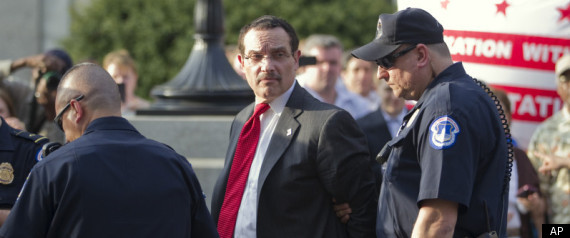
Although the ramifications of DC Mayor Vince Gray's arrest on Monday remain to be seen, it at least may have provided the optic that people like Mr. Plotkin have been waiting for.
Mayor Gray was arrested along with several DC city council members while protesting controversial provisions in the budget agreement negotiated last week between President Obama and congressional Republicans. As part of the agreement, Congress will block DC from using its own money to pay for abortions, and will also terminate a needle-exchange program meant to combat the spread of HIV/AIDS, which afflicts 3 percent of DC residents - the largest percentage in the country. More relevant to the DC Reads program, and to the cause of equal and just education throughout our city, was a separate provision mandating that DC reinstate its private school voucher system.
The return of the school voucher issue is a big deal. Vouchers are taxpayer subsidies given to low-income parents so that they may send their children to a private school of their choice. But could the money that is being set aside for vouchers not instead be spent on shoring up the current budget gap in DC Public Schools, which is forcing schools to scale back essential programs and extra-curricular activities that help students succeed? Republicans also plan on cutting the federal appropriation for DC that helps the city to fund its education system and pay for other essential services. So Congress is setting aside money for DC students to flee public schools, but at the same time continuing to undermine those schools by forcing the city to cut its budget. This makes no sense.
Beyond vouchers, however, the federal power grab currently taking place in Washington gets to several deeper questions. The idea that Congress could impose its will on a city that is meant to represent freedom and democracy would be laughable if it weren't so true and steeped in history. DC was not even permitted to govern itself until 1973, when District residents first voted for a mayor and city council. Even since then, Congress forcibly took control over the city's budget during the 1990s, and continues to dictate what the city can and cannot do with its own resources. Meanwhile, the people of this city have no political recourse because they have no legitimate congressional representation. Part of the reason this hasn't changed is because many people don't even know it's a problem - two-thirds of college educated adults do not know that Washington, DC has no congressional voting rights. Many students on the Georgetown campus don't realize that they live in a city that literally does not have the right to solve its own problems; a city that can have essential programs and services cut or altered at any moment by politicians who have an ideological agenda but could care less about the people that actually live here.
Education has been referred to by Arne Duncan, Al Sharpton, and others within the reform movement as "the civil rights issue of our time." I know for a fact that this is a motivating factor which drives a lot of the work that many of us do within DC Reads. So how can we begin to talk about the injustices surrounding education in America while ignoring the fact that the city where we live and work lacks the basic right to have its voice heard? And what kind of a world are we tutoring and educating our students to live in if we can't also face up to this reality?
If we're to be advocates for students in this city, we also need to be advocates for this city. And recognize that whether it's education reform or any other issue that needs to be addressed, DC will not reach its true potential as long as someone else is pulling its strings.
Showing posts with label vincent gray. Show all posts
Tuesday, April 12, 2011
Tuesday, November 9, 2010
Vincent Gray Ward 8 Town Hall Meeting
By: Hannah Klusendorf
Last week, in a crowded Ward 8 church, fifteen DC Reads coordinators and tutors gathered with nearly a thousand Ward 8-ers to hear future DC mayor, Vince Gray, overview his proposed agenda. A waning sound system and a delayed start aside, the town hall meeting provided me with some illuminating, though vague, information in regards to education. After promising to unite the Wards together to form one DC, Gray turned his attention to creating one DCPS.
Gray claimed that rumblings alleging he would “turn the clock back on education” were “ridiculous.” He spoke of his positive voting record within the Council for education reform measures – a point he brought up many times while on the campaign trail. But that night, he seemed to directly speak out against Rhee and her supporters. Following the primary election results, she did call Gray’s victory “devastating to the children of Washington, DC.” Gray reassured all that there is “only one thing that matters: improving the educational outcome for the children of the District of Columbia.” Duh.
DC is home to a broad and differing range of opinions and ideas, but I do not think (at least I strongly hope) that few find Gray’s statement to be controversial. Some, however, might take issue with his plans for actually accomplishing this necessary yet lofty task. Personally, I have yet to see a fully-realized, concrete plan for actually doing this, as was evident in the following minutes.
Gray stated his vision for a public education system that carries a child from birth to age twenty-four. He stressed the successful creation of formal early childhood education programs within the District. According to him, DC is the first “state” in America to say that there is seat in a pre-kindergarten program for every 3 and 4 year-old. DC Action for Children is working to confirm this. I also tried researching his claim, but I came up with inconclusive results. Drawing upon this supposed success, Gray went on to say that he wants to extend formal education to include children as early as six-months-old because for some children, “three years old is too late.” Not only with this access to education be beneficial for the children, but it will also teach the parents how to be better parents.
As the crowd loudly clapped at this remark, I could not help but think about and question what this proposed system. Clearly, this idea hopes to replant the Harlem Children's Zone in DC, but how exactly will this move look? How much will DC's version resemble this model. What will this program for six-month-olds be? Is it a glorified child care? What does a post-secondary program look like for a twenty-four-year-old still in DCPS? Is it a variation of college or more vocational in nature? Gray’s statements raised many more questions than they answered. He did not elaborate on any specifics of his vision of a DCPS extending from the cradle to adulthood If someone did not know of Geoffery Canada's Harlem Children Zone was prior to this meeting, then he or she would not have any clue as to what Gray's plan even means for DC. Moreover, he prefaced this whole conversation with “We will work on these when we get into better times.” Considering the current state of the economy and the eventual budget cuts DCPS most likely faces, can Gray even guarantee that these broad plans will be enacted?
Another policy that lacked specificity pertained to charter schools. According to him, 30,000 students in DC attend these schools; some parents clearly prefer them. “We,” Gray stated, “Need to work to make sure that public schools are great, too.” Both systems should grow and develop, and parents should be able to choose type of school their children attend. Working with a program that serves in public schools, I agree wholeheartedly with Gray’s statement. Although I had hoped that he would offer concrete ways to promote the growth of public schools, I was glad that at least our mayor is aware of this public school need.
In regards to high school, Gray talked about the merits of developing career and technical components in every high school across the city, so “that kids who want to go to work after the twelve-grade have a set of marketable skills.” Once again, he did not offer a timeline for such plans, reiterating, “We will work on these when we get into better times.” I agree that college is not the life path for every student in the United States. Vocational training would be invaluable for those not planning on pursuing a higher level of education. However, I wished that Gray mentioned the need to foster a college-going culture within DCPS. Attending college is not so unattainable goal as many students might think. True, Gray did bring up the University the District of Columbia and the need to show pride for our state university. He did not, though, link the University to DCPS and its potential college students.
As Gray left the education question to pursue other areas of interest and answer audience questions, I still wanted more. True, the nature of this town hall was not to outline his exact plans for DC. At the time of the town hall, the mayoral election was still a week away. Clearly, he was going to stay away from anything too controversial less he bite the hand that feeds him.
Gray’s speech was a verbal victory lap of sorts. Ward 8 alone gave him 10,500 votes in his primary win. Combined with Ward 7’s 14,500 votes, he received nearly 34% of his votes from these two wards. Being with nearly a thousand community members all clamoring to have their questions answered and their voices heard made me realize the power of an engaged community. Now, that Vincent Gray can officially claim the title of DC’s mayor, I look forward to learning more about his ideas for DCPS. I want to know the specificities of his administration’s idea of education reform. DC Reads started before Rhee assumed the Chancellorship, and it will continue to survive in a Rhee-less DC. Hopefully, Gray’s plans can support our own mission and vision for DCPS.
If you want to learn more about the Ward 8 Town Hall Meeting, the entire event is available to watch here.
Friday, October 15, 2010
Rhee Out, Henderson In
By: Hannah Klusendorf
Since Adrian Fenty's defeat in the DC mayoral primary, there has been much speculation as to the fate of his right-hand woman, Michelle Rhee. After all, she did support Fenty's bid for re-election, and while campaigning for him, she hinted that a victory for Grey would mean resignation for her. It’s no secret that Gray and Rhee have had a pretty rocky relationship in the past. When asked about the possibility of keeping Rhee, Grey responded, "Well, we'll see."
This Wednesday, October 13th, Rhee announced that she would resign as DC Public Schools Chancellor at the end of the month. Gray picked, Kaya Henderson, DC's Deputy Chancellor, as Rhee's interim successor. She first got involved with education reform and policy by working for Teach for America as a middle school Spanish teacher in the Bronx and as the executive director of Teach for America-DC. After her TFA stint, Henderson served Vice-President for Strategic Partnerships in Rhee's The New Teacher Project. She also launched alternative teaching certification programs, including the DC Teaching Fellows Program. Most importantly for all you Georgetown readers, Henderson is a Hoya twice over; she received her undergraduate and master's degrees at Georgetown.
According to Rhee, "She's everything you'd want in a leader. She has the ability to motivate people. She's a critical thinker, and she's an innovative thinker." In light of this glowing praise, why did Gray appoint Henderson, a clear supporter of many Rhee policies? What does Henderson's chancellorship mean for the students of DCPS?
In Henderson, Gray inherits in many ways a mini-Rhee. Both subscribe to the same vision of education reform, chiefly that student success depends most heavily on teacher quality. Henderson was Rhee’s first appointee, and they have been working together for the past decade. In the controversial firing of 98 central office staff members in 2008, Henderson, as deputy chancellor of “human capital,” played an important role. Despite Henderson’s close relationship to Rhee and her policies, Gray and his staff must have seen something in Henderson. Although she successfully negotiated a new labor pact with the Washington Teachers’ Union that bases job security on classroom performance rather than tenure, Henderson maintains a decent relationship with the teachers’ union president, George Parker whose union backed Gray in the primary. Also, according to at least one senior education adviser to Gray, Henderson’s political and presentational skills are stronger than those of Rhee’s.
Whatever the reasons may be for Henderson’s appointment, one must wonder how she fits into Gray’s message of “community engagement and collaboration.” He has said that he “has no intention of micromanaging DCPS,” but how much freedom will Henderson – someone the Gray camp considers to be a permanent chancellor replacement – have to continue with the reforms set in motion by Rhee or even to forge a different path?
According to Henderson, "Our responsibility is to deliver the goods, no matter what the situations our students are in. The reform is in the schoolhouse.” I look forward to watching how she intends on reforming the schoolhouse as the new Chancellor of DCPS.
Subscribe to:
Posts (Atom)